When people talk about worker dormitories, they often focus on one narrow question: where will the workers sleep? In reality, that is only the starting point. A worker dormitory is not just a sleeping facility. It is part of the operating system of a project. It affects labor deployment, shift management, hygiene planning, site order, worker experience, and even the speed at which a project can move from preparation to full operation. In construction, mining, infrastructure, energy, manufacturing expansion, and remote industrial development, the accommodation solution chosen for workers has a direct impact on efficiency.
That is why more project owners, contractors, and camp developers are paying attention to modular dormitory solutions that can be installed quickly, scaled easily, and managed more effectively. Among these options, the folding container house stands out because it addresses several practical needs at the same time. It is fast to install, convenient to transport, suitable for repeated room layouts, flexible enough for different camp arrangements, and reusable over multiple project cycles. These are not minor advantages. For worker dormitory planning, they are often the exact conditions that determine whether a housing solution will succeed in the real world.
Using a folding container house for worker dormitories is not only about saving time during installation. Its deeper value comes from the way it matches the real logic of workforce accommodation. Dormitories need to open fast. They need to be arranged in clear blocks. They often need sanitation support nearby. They may need to expand in phases as the number of workers grows. They also need to remain practical to manage every day. Because folding container house systems are modular, quick to deploy, and suitable for repeated use, they align especially well with these requirements.
This article looks at the benefits of using folding container house for worker dormitories from a broader project perspective. Instead of viewing the dormitory as an isolated building, it considers how the accommodation system affects delivery speed, space planning, labor management, long-term value, and the ability to support different project conditions.
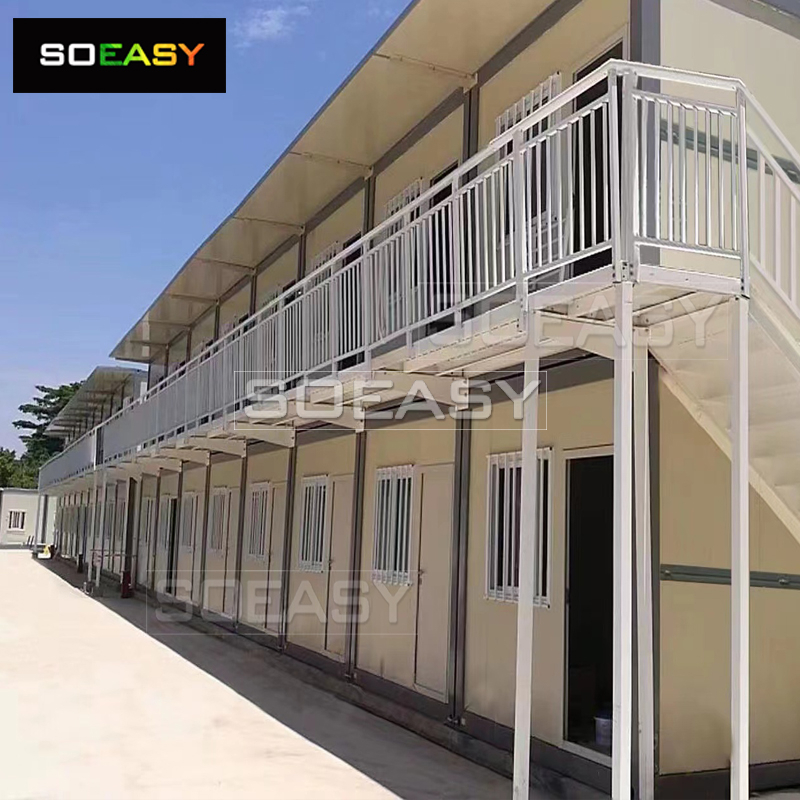
Why Worker Dormitories Need a Smarter Building Solution
Worker housing is often created under pressure. In many cases, a project cannot wait until conventional buildings are slowly completed. Workers must arrive, stay near the site, and begin operations within a limited schedule. If the dormitory system is slow to build, difficult to organize, or hard to expand, that pressure quickly spreads into the wider project.
Accommodation is part of project readiness
A worker dormitory does much more than provide shelter. It supports attendance, reduces daily travel difficulty, improves workforce organization, and allows labor teams to stay close to the jobsite. In remote or large-scale projects, this becomes essential. Without practical accommodation, labor efficiency may drop and project coordination may become harder.
Because of this, dormitory planning should not be treated as an afterthought. It should be considered a major project component that needs the same level of attention as logistics, utilities, and site offices. A folding container house is especially useful here because it allows dormitory areas to be developed quickly and systematically rather than through slow, fragmented construction methods.
Worker dormitories must balance speed and order
There is a common misconception that temporary worker housing only needs to be cheap and fast. But poorly organized dormitories often create problems later. Congested layouts, slow installation, weak sanitation planning, and limited flexibility can all reduce the overall effectiveness of the camp. A good dormitory solution should therefore balance quick deployment with practical order.
Folding container house systems help achieve that balance. Their modular form makes it easier to arrange units in clear rows, zones, and functional clusters. This improves not only construction speed but also daily use and site management.
Benefit One: Fast Setup Supports Faster Labor Mobilization
The first major advantage of using folding container house for worker dormitories is speed. In workforce accommodation projects, speed is not just convenient. It is operationally critical. If the dormitories are delayed, the workforce may not be able to stabilize on site, and the project may lose momentum during its most important early stages.
Quick installation helps projects start sooner
According to the product information, the Folding Container House can be installed in roughly four steps and about four minutes with a crane. For worker dormitories, this feature is extremely valuable. A single unit may install quickly, but the real advantage appears when many units are deployed together. In a large worker camp, time saved per unit can turn into major schedule gains across the full accommodation area.
This makes it easier for project teams to move from an undeveloped site to a usable dormitory zone in a much shorter time frame. Workers can begin occupying the space earlier, managers can organize shifts more effectively, and the site can transition into a more stable operating stage.
Rapid deployment is ideal for high-volume accommodation
Worker dormitories are usually built in repeated quantities. One row may mirror another. The same room arrangement may be used again and again across the camp. Folding container houses are well suited to this because their installation model is inherently repeatable. Instead of building every room from the ground up, the project can rely on a more consistent deployment rhythm.
That repeatability is especially important when a project needs dozens or hundreds of dormitory spaces. The more standardized the installation process is, the more predictable the camp rollout becomes.
Fast installation can reduce construction congestion
On a busy project site, too much prolonged building activity can create congestion. Materials, labor teams, equipment, and utilities may all compete for limited space. A folding container house reduces part of that pressure because less structural work must be completed after the unit arrives. This allows the project team to spend more attention on arrangement, connections, and commissioning rather than lengthy onsite assembly.
Benefit Two: Dormitory Planning Becomes More Organized
Worker housing must be manageable at scale. Even if the units themselves are simple, the overall dormitory environment must be easy to understand, easy to maintain, and easy to supervise. One of the strongest benefits of folding container house is that it supports organized layout planning rather than random temporary placement.
Modular repetition improves camp clarity
Because folding container houses are modular, they naturally support repeated room patterns. This is very useful for worker dormitory design. Repeated units make it easier to create standardized housing blocks, allocate room numbers, assign teams by area, and develop routine maintenance processes. In practical terms, the camp becomes easier to operate because the physical environment is more coherent.
Clear physical organization often leads to clearer human organization. Workers know where they are assigned. Supervisors can monitor occupancy more efficiently. Facility teams can manage cleaning and repair more systematically.
Separate zones can be planned more logically
A dormitory camp is not only made of sleeping rooms. It often includes shower rooms, public toilets, service spaces, storage areas, and sometimes office or supervision rooms nearby. Since the folding container house product line can support different layouts such as empty units, one-bedroom and one-bathroom units, public toilets, and shower rooms, project teams can plan worker living areas in a more realistic way.
Instead of forcing every need into the same building type, the camp can be divided into clearer functional zones. This makes the dormitory area more usable in daily life and helps support better living conditions for the workforce.
Combined units allow more than one-room thinking
Another practical benefit is that several units can be combined to create larger spaces. In worker dormitory projects, this can be useful for shared functions, administration areas, staff coordination rooms, or support uses that need more interior space than a single unit provides. This makes the system more versatile than a simple one-box sleeping solution.
Benefit Three: Transport Efficiency Matters More Than Many Buyers Expect
When evaluating worker dormitory solutions, buyers often spend most of their time comparing prices or room layouts. But in many real projects, transportation has a major impact on the final cost and delivery speed. A dormitory system that is hard to move can cause delays and unnecessary expense long before installation begins. This is one reason why folding container house offers such strong value.
Folded structure improves logistics efficiency
The folding design makes the units more efficient for transportation and storage when not in use. For worker dormitory projects, this is especially important because accommodation often needs to be delivered in batches and installed according to site progress. Better transport efficiency means the project team can handle more units with less logistics pressure.
This is particularly useful for export projects, remote industrial locations, inland developments, and camp sites where access conditions are not always ideal. The easier the product is to ship and stage, the easier the dormitory rollout becomes.
Phased project delivery becomes more practical
Not every workforce arrives at the same time. Some projects begin with a core team and then expand labor capacity as activity increases. Folding container house systems fit this pattern well because units can be delivered and installed in phases. That allows developers to align accommodation construction with actual staffing demand.
This reduces the need to overbuild too early and gives project teams more flexibility in both budget management and site planning.
Site storage and staging are easier to control
During the early phase of a project, space is often limited. Equipment, materials, roads, and utility works may already be crowding the site. A building system that is easier to store and stage before installation helps avoid unnecessary disorder. Folding container houses are strong in this respect because the folded format supports more efficient temporary handling before final placement.
Benefit Four: Worker Comfort and Daily Usability Can Be Supported More Effectively
A worker dormitory does not need luxury, but it does need practicality. Housing that is difficult to use, poorly arranged, or slow to become operational can create a poor living experience, even if it is technically complete. A folding container house offers important usability benefits because it is designed to become functional quickly and to support different dormitory-related purposes.
Ready-to-use deployment shortens the gap between installation and occupancy
According to the product information, once fully unfolded and equipped with an electricity system, the unit can be put into use at any time. That is a major advantage for worker dormitories. It means the building is not only fast to set up but also fast to transition into daily accommodation use.
This is valuable because the workforce often needs to move in soon after the dormitory block is installed. Reducing the delay between structural placement and actual occupancy helps stabilize camp operations faster.
Different layout options support more realistic living arrangements
Worker housing is rarely just about beds. Some projects need simple sleeping units. Others need sanitation units, private room configurations for certain staff, or service facilities connected to the dormitory zone. With layout possibilities that include empty units, one-bedroom and one-bathroom units, public toilets, and shower rooms, the folding container house system offers a more complete response to how worker camps function in practice.
This allows the accommodation environment to be planned with greater realism and usability, rather than with a single rigid template.
Broader application range strengthens the dormitory ecosystem
The product is not only suitable for accommodation. It is also described as appropriate for labor camp, site office, clinic, classroom, storage, emergency function, and outdoor cafe use. In worker dormitory planning, this broad application range is highly valuable because the housing area is often part of a larger camp environment. A system that can support not only sleeping space but also service and support functions helps create a more integrated living zone.
Benefit Five: It Adapts Well to Different Workforce Scales
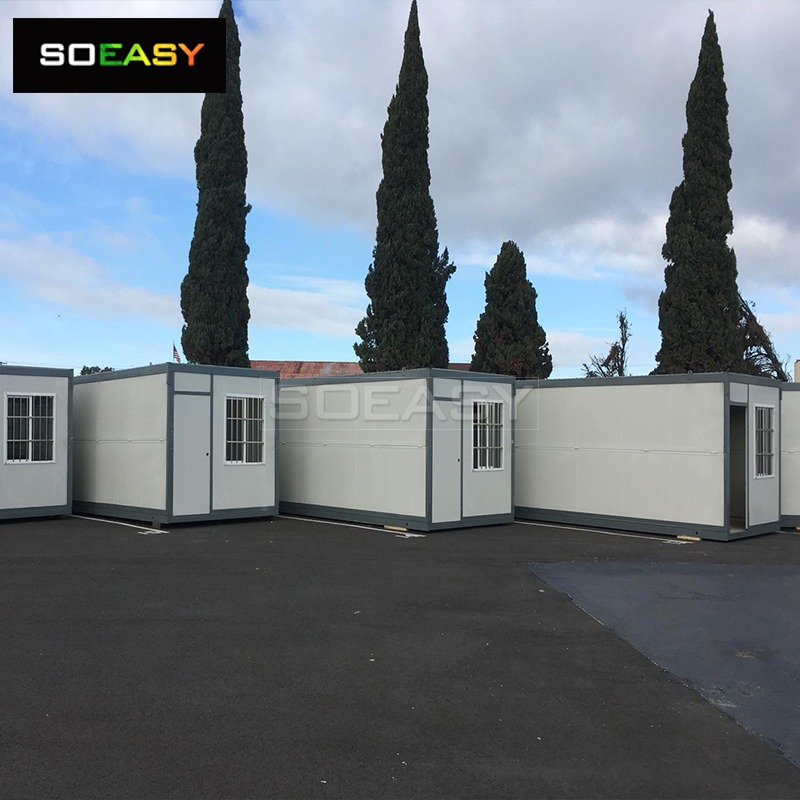
One of the practical challenges in worker dormitory development is uncertainty. The number of workers may increase. A project may extend longer than expected. The camp may need new sections for different teams or functions. A rigid building strategy often struggles under these changing conditions. Folding container house systems are much better suited to staged growth and adaptation.
Scalable planning helps avoid overinvestment
Because modular units can be added in stages, project teams do not always need to build the full dormitory capacity at once. This helps control spending at the beginning of the project and leaves room for later expansion if workforce numbers rise. For many contractors and developers, this staged investment model is much more practical than committing all resources upfront.
Expansion can follow actual project growth
As the camp develops, additional dormitory rows, sanitation blocks, or service units can be introduced in a more organized way. The modular format allows new units to follow the original planning logic rather than creating a mismatched patchwork. That supports better camp quality over time and helps the dormitory remain manageable as it grows.
Temporary and semi-permanent needs can both be addressed
Some worker dormitories are intended for a short project cycle. Others stay in operation for years. Folding container house is useful in both cases because it combines rapid deployment with longer-term practicality. This flexibility makes it attractive to buyers who need a solution that can serve different project durations without completely changing building strategy.
Benefit Six: Reusability Strengthens the Financial Logic
A worker dormitory is often a necessary investment, but it should not become a wasted one. One of the biggest benefits of using folding container house is that the units can continue to create value even after one project is finished. This gives the dormitory solution stronger economic logic than many traditional temporary structures.
Reuse across projects increases asset value
The product can be unfolded when needed and folded when not needed. That means a company can use the units for one project, then recover, store, transport, and deploy them again for another. In industries where workforce accommodation is repeatedly needed across different locations, this is a major financial advantage.
Instead of seeing dormitory construction as a one-time cost, buyers can view the units as reusable operational assets.
Long service life improves return over time
The stated service life of more than 20 years further strengthens the value proposition. Durability matters in worker dormitory applications because the buildings may be exposed to repeated handling, relocation, and long operating cycles. A longer service life supports a stronger return on investment by spreading the product’s value over more years and more projects.
Reuse supports a more efficient resource model
Reusability is not only about cost. It also reflects a more efficient use of resources. When companies can redeploy the same dormitory units instead of repeatedly rebuilding from scratch, they reduce wasteful duplication and improve the overall sustainability logic of temporary accommodation planning.
Benefit Seven: It Matches the Direction of Modern Workforce Housing
Worker dormitories are changing. Buyers today are not only looking for the cheapest temporary room. They increasingly want housing systems that can be deployed faster, organized better, expanded more easily, and managed more professionally. Folding container house aligns well with this shift because it combines speed with broader project practicality.
The market now values flexibility as much as speed
Fast installation is still important, but buyers also want adaptability. They want products that can work in different site conditions, support multiple functional needs, and adjust as the project evolves. Folding container house systems deliver that kind of flexibility while still preserving their fast-install advantage.
Integrated camp planning is becoming more important
Modern project camps are expected to function more coherently than before. Rather than creating scattered temporary spaces, developers increasingly prefer integrated camp planning with organized dormitory blocks and supporting service zones. Because folding container house can be used in accommodation, office, clinic, sanitation, storage, and emergency applications, it supports this integrated approach more effectively.
Operational simplicity is gaining more value
In a competitive project environment, simple solutions are often the most valuable. A dormitory system that is easier to transport, easier to install, easier to expand, and easier to reuse helps reduce management burden across the project lifecycle. This operational simplicity is one of the strongest hidden advantages of the folding container house model.
Conclusion
The benefits of using folding container house for worker dormitories go far beyond quick assembly. It helps projects mobilize labor faster, creates more organized accommodation layouts, improves transport and staging efficiency, supports better daily usability, adapts to changing workforce scale, and offers stronger long-term asset value through reuse. For modern worker housing, these are not separate advantages. They are interconnected strengths that make the dormitory solution more practical from planning to operation and from first deployment to future reuse.
For buyers who need a dependable supplier for worker dormitory and camp accommodation projects, FOSHAN SOEASY MODULAR HOUSING CO LTD offers strong manufacturing and project support experience. As the high-level brand of WELLCAMP Group, SOEASY has more than 19 years of experience in export-standard prefab housing, 4 production bases covering over 100,000 square meters, and a complete product range that includes Folding Container House, expandable container house, flat pack container house, detachable container house, prefab houses, and steel structure solutions. With coordinated sales, engineering, design, production, and QC teams, SOEASY is well positioned to provide one-stop support for worker dormitory projects from solution design to delivery and after-sales service.


