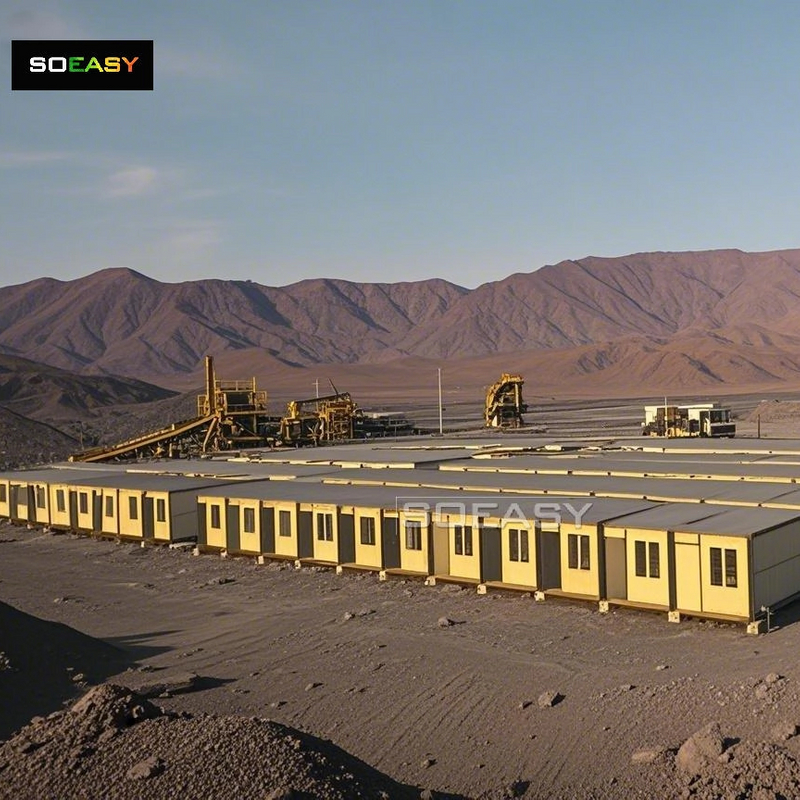
Large camp projects are fundamentally different from small temporary site setups. They are not just about placing a few units on open ground and creating a place for short-term shelter. A true large camp project often needs to function as a complete operational environment. It may include modular dormitories for workers, office areas for management teams, sanitation blocks, clinics, storage rooms, meeting spaces, service areas, and public-use facilities that support everyday life on site. In many cases, the camp becomes the real center of project operations long before the main development itself is fully established.
Because of this, project owners are under pressure to find building solutions that are not only fast, but also scalable, practical, easy to organize, and suitable for repeated use. Traditional construction can be too slow. Conventional temporary buildings may solve one problem but create others in transport, installation, or flexibility. This is where the value of a folding container house becomes especially clear. For large camp projects, it offers a strong balance of speed, modular efficiency, transport convenience, layout adaptability, and reuse potential.
A folding container house is not attractive simply because it looks modern or modular. Its real strength is that it matches the way large camp projects are actually planned and executed. Camps are built in phases. They often need to open quickly. They usually require repeated room types. They must be easy to expand, easy to manage, and practical to relocate or reuse when project demands change. These are exactly the kinds of needs that make folding container house systems an ideal option.
Large Camp Projects Require a Different Kind of Building Logic
Many people underestimate how complex a large camp project can be. At first glance, it may seem like a simple collection of temporary rooms. In reality, a camp often has to support hundreds of people and provide a structured environment for living, working, and daily operation. That means the building system chosen for the camp affects not just construction speed, but also project efficiency, labor organization, logistics, cost control, and future asset use.
Large camps are driven by operational urgency
In many industries, a large camp needs to be established before the main project can run efficiently. Construction workers need accommodation before site work reaches full speed. Supervisors need office space to manage daily operations. Technical teams may need rooms for meetings, equipment storage, or temporary support functions. In remote areas, a camp is not secondary infrastructure. It is primary infrastructure.
This urgency changes the building standard. The ideal solution cannot depend on long site preparation, complicated construction sequencing, or slow finishing work. It needs to move from delivery to use in as little time as possible. Folding container house systems are highly aligned with this requirement because their deployment model is built around quick setup and practical readiness.
Large camps must work as organized systems
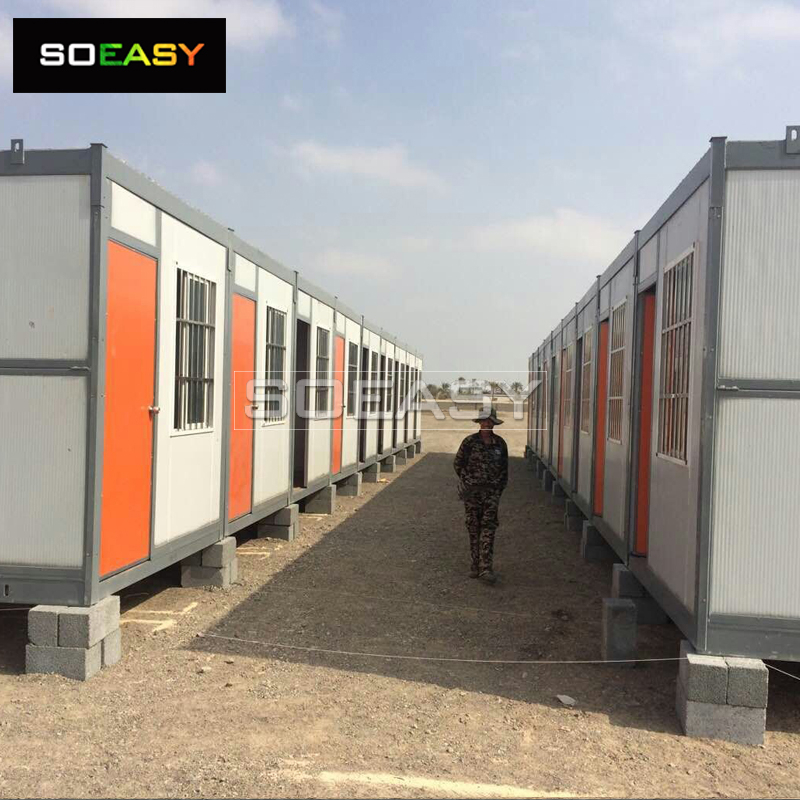
A real camp is not only a housing cluster. It is a coordinated system of spaces. Worker dormitories, public toilet areas, shower rooms, management offices, clinic units, storage rooms, and service spaces all need to fit into one site plan. If the building product is too rigid, camp planning becomes fragmented. If the building process is too slow, project coordination becomes difficult. If the building system is hard to expand, the camp may stop matching the project’s actual growth.
Folding container house is ideal in this context because it is modular by nature. Instead of treating each structure as an isolated building, project teams can treat the camp as a repeated and organized unit-based system. This makes planning more efficient and helps the whole camp function more like an integrated project asset rather than a group of disconnected temporary rooms.
Speed Is the First Major Advantage of Folding Container House
When large camp projects are evaluated, one of the first questions is always how quickly the site can become operational. Time pressure affects almost every decision, from labor mobilization to project cash flow. A building solution that significantly shortens deployment time can therefore create value far beyond the construction stage itself.
Rapid installation shortens the path from delivery to operation
According to the product information, SOEASY’s Folding Container House can be installed in around four steps and roughly four minutes with a crane. That is a very important advantage for camp construction. In a project involving dozens or hundreds of units, installation speed per unit is multiplied across the whole development. The faster each unit is placed and opened, the faster the camp can move toward occupancy and practical use.
This matters especially for labor-intensive projects. If a camp is delayed, worker accommodation is delayed. If worker accommodation is delayed, field activity may be delayed as well. In this sense, rapid installation is not only a construction benefit. It is a project management benefit.
Fast deployment supports high-volume camp construction
The phrase “7 days can build a city” is clearly promotional language, but the core idea behind it is highly relevant. Large camp projects often involve repetitive unit installation on a substantial scale. The product must therefore perform well not only in a single demonstration unit, but also in batch deployment. Folding systems are especially suitable for this because they are designed around repeatable and efficient installation processes.
For project managers, this kind of deployment speed creates planning confidence. It reduces the risk of camp bottlenecks, allows earlier occupancy, and supports phased site opening when the workforce increases in stages.
Shorter installation can reduce site complexity
Another reason speed matters is that long onsite construction usually increases coordination difficulty. More labor is needed, more time is exposed to weather risk, and more site supervision is required. A folding container house simplifies much of this process by reducing the amount of structural work that must happen after the unit reaches the site.
This can be especially helpful in remote project environments where construction resources are limited. Instead of depending on extended building operations, the project can focus on crane placement, unit arrangement, utility connections, and camp commissioning. That is a much more manageable path for many large camp developments.
Transport Efficiency Makes Large Camp Projects More Practical
For small building jobs, logistics may be a secondary issue. For large camp projects, logistics is central. If transportation is inefficient, the cost and difficulty of project execution can rise quickly. This is why the folding nature of the product is such an important advantage. It is not only about how the house performs after it is installed, but also about how efficiently it moves before installation.
Folding design supports better shipping efficiency
Because the unit can be folded when not in use, it is more transport-efficient than many conventional modular structures. This becomes highly valuable when a camp project requires many units to be delivered to one location. Better loading efficiency can help optimize shipping plans, reduce the burden of repeated transport, and make large-scale delivery more manageable.
In export-oriented business, this advantage is even more important. International camp projects often depend on careful container loading, port scheduling, and inland transport timing. A product that is easier to ship at scale has a clear commercial advantage.
Large projects benefit from more organized delivery sequencing
In a major camp deployment, materials do not always arrive all at once, nor should they. Usually, project teams need organized shipment sequences based on installation priorities. Accommodation may come first, office space second, sanitation blocks next, and support spaces after that. Folding container houses fit well into this kind of phased logistics logic because they are practical to batch, move, store temporarily, and deploy according to site progress.
That gives project teams more freedom to manage both budget and schedule. Instead of overcrowding the site with bulky building components too early, they can align delivery more closely with actual installation readiness.
Storage and site staging become easier to manage
Large camp sites are often busy, especially in the early stages of development. Roads may be temporary, unloading space may be limited, and utility works may still be ongoing. A building solution that is easier to stage before installation is therefore extremely useful. Folding units help reduce storage pressure and make temporary site organization more efficient.
This matters because camp construction does not happen in isolation. It happens alongside grading, utilities, access planning, security arrangements, and often the first stage of the main project itself. Any building product that simplifies site staging makes the entire project easier to control.
Modularity Gives Camp Planners Greater Freedom
One of the strongest reasons why folding container house is ideal for large camp projects is that it is modular in a genuinely useful way. Modularity in this context is not just a marketing term. It means the product can be arranged, repeated, combined, and adapted to fit different camp layouts and operational needs.
Multiple units can create larger functional zones
The product information indicates that several units can be combined to create bigger spaces. This is a major advantage in camp planning because not every area of a camp should remain as a small isolated room. Some spaces need to be enlarged for practical use. Offices may need more open interior space. Meeting rooms may need wider layouts. Welfare or service areas may need combined units to improve circulation and usability.
Because folding container houses can work in combination, they support this type of planning much better than a fixed one-unit-one-function approach.
Standard units simplify large-scale layout planning
At the same time, standardized modular units make large projects easier to design. When the main structural logic is repeated, camp designers can create more organized accommodation blocks, cleaner circulation paths, and more efficient functional zoning. Repetition is not a limitation in camp design. In most cases, it is a practical advantage.
For example, repeated accommodation units can form dormitory rows, repeated sanitation units can be grouped into service zones, and support functions can be placed at logical intervals across the camp. This kind of site planning becomes easier when the building system itself is based on clear modular rules.
Different project types can use the same system logic
Large camps vary from project to project. Some focus on labor accommodation. Some need stronger office support. Some must include emergency or medical spaces. Yet many of these different functions can still be built from one product family if the system is flexible enough. Folding container house is valuable precisely because it is not restricted to one narrow use case.
That makes procurement easier and can simplify maintenance, future expansion, and long-term asset planning. Instead of sourcing completely different structures for every need, project teams can work with one more coherent modular solution.
It Is Highly Suitable for Camp Accommodation and Support Functions
The success of a large camp depends on whether it can support real daily life. A building product may be fast to install, but if it cannot meet accommodation and support needs properly, it will not perform well as a camp solution. Folding container house stands out because its application range matches the actual needs of camp environments.
It works well for modular dormitory-style accommodation
Worker housing is often the largest part of a camp project. These spaces need to be practical, repeatable, and efficient to deploy. Folding container house is highly relevant here because it supports accommodation use and can be repeated at scale for modular dormitory arrangements. For large projects, this helps maintain consistency in layout, utility planning, and occupancy management.
Consistency is important in labor accommodation because it affects everything from cleaning and maintenance to allocation and supervision. A repeated modular system makes these tasks easier to control.
It can support office, clinic, storage, and service use
According to the product information, the Folding Container House is suitable for labor camp, site office, accommodation, clinic, classroom, storage, emergency functions, and outdoor cafe applications. This is highly significant for large camp development because camps are almost never single-purpose environments.
A serious camp usually needs a combination of private, shared, operational, and service spaces. Being able to use the same overall product type for multiple functions is one of the main reasons the system is ideal for large camp projects. It supports greater planning unity and avoids an overly fragmented building strategy.
Ready-to-use deployment improves practical usability
Another important point is that the product is ready to use after being fully unfolded and equipped with an electricity system. This is a practical advantage, not just a technical detail. In camp environments, the time between installation and occupancy matters. Long secondary fit-out periods can delay the usefulness of the building even after it is physically in place.
A product that reaches functional readiness quickly is much more valuable for camp developers who are working under site pressure and occupancy deadlines.
Customization Helps Large Camps Match Real Project Conditions
No two large camp projects are exactly the same. One project may need basic labor accommodation. Another may require a more organized combination of dormitories, management rooms, public toilets, shower areas, and support functions. Some camps are intended for short project cycles, while others are expected to remain in operation much longer. That is why customization is so important.
Different internal layouts support different camp roles
SOEASY’s product information mentions different design options such as empty units, one-bedroom and one-bathroom layouts, public toilets, and shower rooms. This helps the folding container house move beyond a single standard format. Instead, it becomes a flexible system that can support the layered needs of camp operations.
For project planners, that means one product family can cover multiple room types without losing overall modular consistency. This is an effective balance between standardization and usability.
Customized combinations improve site planning quality
Large camps should not only be fast to build. They should also be logical to use. Customized combinations help improve the planning quality of the site by allowing project teams to create more suitable living clusters, sanitation zones, and management areas. This can improve daily circulation and create a more organized camp environment.
Better planning also supports future flexibility. If the camp needs to expand, the building system can continue to grow in a more coherent way instead of becoming an unstructured patchwork of different temporary structures.
Different markets can apply different camp standards
Since many modular housing projects serve different countries, sectors, and budget levels, customization also helps the product align with varying project expectations. Some buyers may prioritize fast and economical camp construction. Others may want a more refined modular accommodation solution for better living standards or stronger project image. A flexible folding container house system can adapt more effectively to these different priorities.
Reusability Gives the Product Stronger Long-Term Value
One of the biggest weaknesses of many temporary project buildings is that they lose value once the first project ends. If they cannot be efficiently dismantled, moved, or reused, their economic logic becomes much weaker. This is one of the areas where folding container house has a clear advantage in large camp projects.
Fold when not needed, deploy when required
The product is designed to be unfolded when needed and folded when not needed. This creates an important reuse logic. For companies that handle repeated camp development across multiple project sites, the camp does not have to be treated as a disposable structure. Instead, it can be treated as an asset that supports one project, then another, then another.
That is particularly valuable in industries where project locations change frequently but accommodation demand remains constant over time.
Long service life strengthens return on investment
The stated service life of more than 20 years is another key point. In large camp projects, the initial purchasing decision is rarely based only on the first installation cycle. Buyers also consider how many times the units can be used, how well they can hold up through repeated deployment, and whether they can support multiple project phases over many years.
A longer service life improves the economic argument for modular camp solutions because it spreads the value of the building asset across more time and more projects.
Reuse supports more sustainable project thinking
Although cost and speed are often the first priorities, reuse also connects with broader sustainability goals. A building system that can be folded, transported again, and reused reduces the need to repeatedly create entirely new temporary structures for each project. For companies seeking more responsible resource use, that is an additional advantage.
Why Folding Container House Fits the Future of Large Camp Development
Large camp projects are evolving. Buyers are paying closer attention to construction speed, space efficiency, worker accommodation quality, reuse potential, and full-project coordination. They are not only asking whether a structure is temporary or permanent. They are asking whether it is practical, scalable, and commercially sensible over the whole project cycle.
The market increasingly values speed plus flexibility
In the past, fast temporary buildings were often associated with compromise. Today, buyers expect more. They want speed, but they also want functional planning, better transport efficiency, easier asset management, and adaptable design. Folding container house responds well to that shift because it combines multiple project advantages in one system.
That is why it is becoming more relevant not only in traditional labor camp applications, but also in modular accommodation strategies that demand greater efficiency and smarter deployment logic.
Large camp construction is becoming more modular
As project developers become more experienced with prefab and modular solutions, they increasingly prefer systems that can be repeated, expanded, and integrated into larger plans. Folding container house fits that direction naturally. It is not just a product for isolated temporary use. It is a building block for structured camp development.
For large projects, that distinction matters. It means the product can support both immediate urgency and long-term planning.
Conclusion
Folding container house is ideal for large camp projects because it addresses the full reality of camp construction rather than only one part of it. It offers rapid installation, better transport efficiency, practical modularity, flexible combinations, wide application potential, customized layout options, and strong reusability. These advantages make it highly suitable for labor camps, modular dormitory arrangements, site offices, sanitation blocks, clinics, storage areas, and other support spaces required in large project environments. In short, it is not simply a quick shelter solution. It is a scalable and project-oriented modular housing system that matches how modern large camps are planned, delivered, and managed.
For buyers looking for dependable support in this field, working with an experienced manufacturer is just as important as choosing the right product. FOSHAN SOEASY MODULAR HOUSING CO LTD, the high-level brand of WELLCAMP Group, has more than 19 years of experience in export-oriented prefab housing and camp project solutions. With 4 production bases, over 100,000 square meters of manufacturing area, a wide modular housing product range, and coordinated teams covering sales, design, engineering, production, and QC, SOEASY is well positioned to provide one-stop support for large camp development from planning to delivery and after-sales service.


